


The project
FUI project co-funded by Bpifrance and the Occitanie Region. Partners: Dynas+, Thiot Ingénierie, NAWA Technologies, École des Mines d'Albi (Institut Clément Ader), CEA Saclay, CEA CESTA, Airbus Defence and Space. The risk posed by space debris is one of the major challenges for the sustainability of orbital operations.
The intermediate debris challenge
Among the millions of debris in orbit:
- large debris, tracked from the ground and avoided through orbital maneuvers
- submillimeter debris, accounted for in current structural design
- intermediate-size debris (a few mm to a few cm), untracked but capable of causing major damage (speeds up to 16 km/s)
The objective of ATIHS was to help eliminate this third category by strengthening the protection of satellites against lethal, untraceable hypervelocity debris.
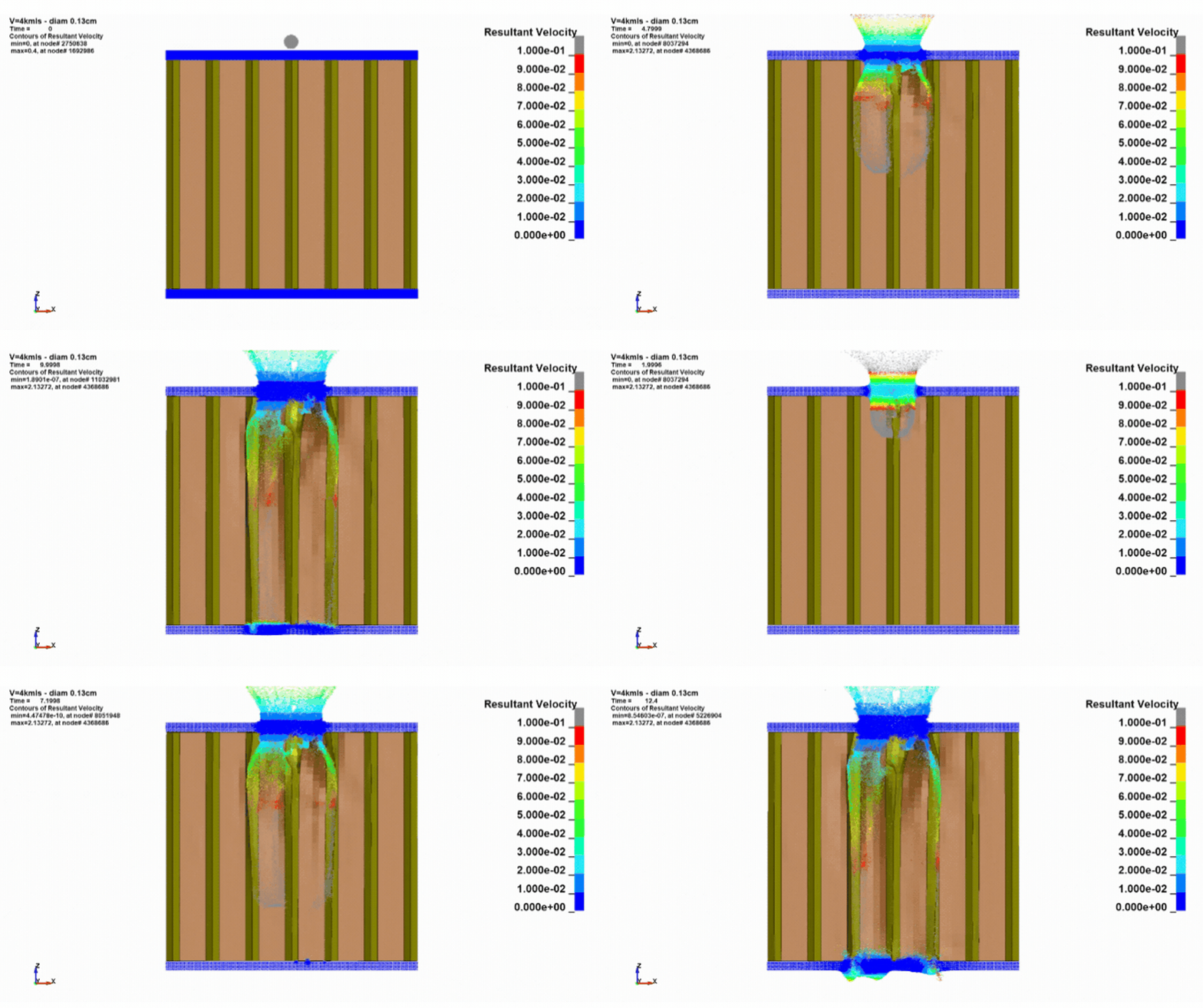
A strategy structured around three areas
- Design of innovative protective structures: optimize the nature of the skins (carbon, PBO/Zylon, aligned nanotubes, etc.) then design innovative structural assemblies as alternatives to honeycomb panels.
- Ramp-up of hypervelocity testing capabilities (Thiot Ingénierie), beyond 7 km/s, the threshold at which materials can change state (melting, vaporization).
- Strengthening of numerical modeling: making simulations more reliable based on the tests and reproducing extreme phenomena (fragmentation, sublimation, perforation, dispersion) via calibrated SPH models.
Key results
- Materials and structures: numerous materials tested in hybrid configurations, resulting in an interlocking corrugated architecture that was the subject of a patent application by Dynas+.
- Hypervelocity testing: new testing capabilities (launchers and sabots) reaching more than 10 km/s, and a record number of shots (nearly 100).
- Numerical modeling: methods adapted and calibrated through fine correlation with the tests, with the ability to model the state changes of materials under shock.
Toward a new generation of space shielding
By combining materials, testing, and simulation, ATIHS paves the way for a new generation of protective structures that are lighter and higher-performing:
- robust technical criteria for designing structures optimized against debris impacts from a few mm to a few cm
- reliable numerical models, supported by an exceptional test database
- innovative architectures, ready to be transferred to operational space applications

